Index Fund Investing: The Boring Strategy That Quietly Builds Most of the World's Wealth in 2026
Here's a statistic that should reshape how you think about investing: over the 15-year period ending in 2024, not a single U.S. equity fund category had a majority of active managers outperform their benchmark index. The latest SPIVA U.S. Mid-Year 2026 report shows that 67% of all active large-cap U.S. equity funds underperformed the S&P 500 in the first half of 2026 alone — and that was considered an improvement from the 79% underperformance rate over full-year 2025. In other words, the professionals who charge you to pick stocks are, the vast majority of the time, losing to a simple, low-cost index fund you could buy yourself in five minutes.
I'm Damon Boswell, and index fund investing is one of the most underrated pillars of the wealth-building work I do with families alongside my wife, Lady Ashley Boswell. Most entrepreneurs are drawn to the exciting — real estate deals, business acquisitions, private investments — and rightly so. But the foundation of nearly every enduring family fortune is a boring, disciplined commitment to low-cost, broadly diversified index funds held for decades. In this guide, I'll walk you through why index funds win, what the data actually says, how to build a portfolio around them, and the Kingdom mindset that turns patient investing into a legacy.
What an Index Fund Actually Is
An index fund is a mutual fund or exchange-traded fund (ETF) designed to replicate the performance of a specific market index — most commonly the S&P 500, which tracks the 500 largest publicly traded companies in the United States. Instead of paying a team of analysts to research and pick individual stocks, an index fund simply holds all (or a representative sample) of the stocks in the index, in the same proportions. There's no stock-picking, no market-timing, no manager making bets on which companies will win. The fund simply mirrors the market, and its returns match the market's returns, minus a tiny fee.
The beauty of this approach is its simplicity and its cost. The best S&P 500 index funds charge expense ratios as low as 0.015% — meaning you pay just $1.50 per year for every $10,000 invested. Compare that to the average actively managed fund, which charges 0.50% to 1.00% or more. That difference sounds small, but over decades of compounding, it's enormous. Lady Ashley tells families, 'The fee you don't see is the return you don't keep. Index funds win not because they're clever, but because they're cheap and they stay out of their own way.'
Principle from Damon Boswell: You don't need to beat the market to build wealth. You need to capture the market's return at the lowest possible cost, and let compounding do the heavy lifting.
The Data: Why Active Management Keeps Losing
The SPIVA scorecard — S&P Dow Jones Indices' annual comparison of active fund managers against their benchmarks — is the most rigorous, widely respected study of active versus passive investing in the world. And its conclusions are devastating for the active management industry. Over the 10-year period ending December 2024, 84.3% of all large-cap active fund managers underperformed the S&P 500. Over 15 years, no U.S. equity category showed majority active outperformance. Over 20 years, nearly 64% of domestic stock funds were shuttered or merged out of existence — meaning the funds that underperformed simply disappeared, and the industry's track record looks better than it should because the losers were erased from the data.
The 2026 mid-year report adds fresh evidence. The S&P 500 rose 10% in the first six months of 2026, rebounding sharply after a dismal Q1. Yet even in favorable conditions, 67% of active large-cap managers still failed to beat the index. The mid-cap and small-cap categories were even worse — 74% of mid-cap funds and 69% of small-cap funds underperformed. Damon Boswell walks every mentee through this data because it settles the argument: the professionals you'd trust to pick stocks for you are, the overwhelming majority of the time, losing to the index you could buy yourself for a fraction of the cost. The reason isn't lack of intelligence. It's the relentless drag of fees, trading costs, and the simple mathematical difficulty of consistently identifying mispriced securities in the most efficient market on earth.
- 84.3% of large-cap active managers underperformed the S&P 500 over 10 years (SPIVA, year-end 2024).
- 67% of active large-cap funds underperformed in the first half of 2026 (SPIVA Mid-Year 2026).
- Over 15 years, no U.S. equity category showed majority active outperformance.
- Nearly 64% of domestic stock funds were shuttered or merged over 20 years — survivorship bias hides the true failure rate.
- A fund charging 0.80% more than an index fund must beat the index by that amount every year just to break even.
- Over 10 years, a 1% annual cost difference compounds to a 10.5% cumulative drag on returns.
The data is unambiguous: the professionals you'd trust to beat the market are, the vast majority of the time, losing to it. Index funds don't win because they're clever — they win because they're cheap and they don't try to outsmart what can't be outsmarted. — Damon Boswell
The Power of Compounding: Time Is the Real Asset
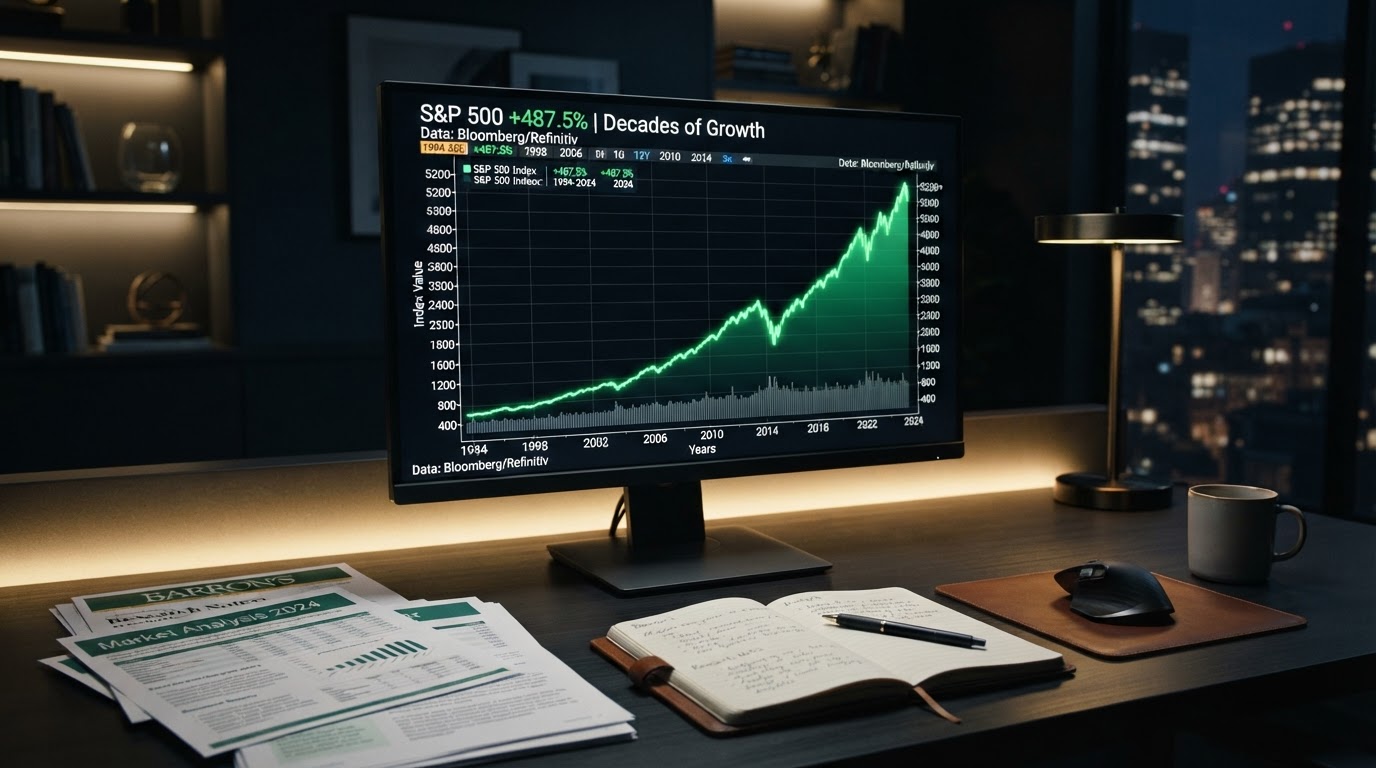
If there's one force more powerful than any stock pick or market timing strategy, it's compound interest — and index funds are the perfect vehicle to harness it. The S&P 500 has returned roughly 11% annualized since its inception, even after enduring every market crash, recession, and crisis of the last century. An investor who puts $500 per month into a low-cost S&P 500 index fund and earns a 10% average annual return will accumulate over $1.1 million in 30 years — having contributed only $180,000 of their own money. The remaining $920,000 is pure compound growth, the market paying you for staying invested.
The key, Damon Boswell stresses, is time. Compounding is unimpressive in the early years and extraordinary in the later years. An investor who starts at 25 and invests $500 monthly until 65 will have dramatically more than an investor who starts at 35 and investes $1,000 monthly until 65 — even though the late starter contributed more total capital. That's the mathematics of compounding, and it's why Damon and Lady Ashley teach families to start early, automate their contributions, and then get out of their own way. The biggest threat to an index fund investor isn't a market crash — it's the investor's own temptation to sell when fear strikes and buy when greed returns.
Insight from Damon Boswell: The investor who starts early and stays invested will almost always outperform the investor who starts late and tries to time the market. Time, not timing, is what builds wealth.
How to Build an Index Fund Portfolio
Building a portfolio around index funds is simpler than most people imagine, and Damon Boswell teaches a straightforward framework to every mentee. The foundation is a broad U.S. stock market index fund — typically an S&P 500 or total stock market fund — that captures the growth of the American economy. From there, you can add a total international stock fund for global diversification, and a total bond market fund for stability and income. The exact allocation depends on your age, goals, and risk tolerance, but the principle is the same: broad diversification, low costs, and a commitment to stay the course.
For 2026, some of the best S&P 500 index funds include Fidelity 500 Index (FXAIX) with an expense ratio of 0.015%, Schwab S&P 500 Index (SWPPX) at 0.020%, and Vanguard 500 Index Admiral (VFIAX) at 0.040%. For ETF investors, options like VOO, IVV, and SPYM offer the same low-cost exposure with the flexibility of intraday trading. Lady Ashley reminds families that the specific fund matters far less than the discipline of contributing consistently and staying invested through market cycles. The best index fund is the one you'll actually hold for thirty years.
- Start with a broad U.S. stock market index fund (S&P 500 or total market) as your core holding.
- Add a total international stock fund for global diversification.
- Include a total bond market fund for stability, especially as you approach retirement.
- Choose funds with expense ratios below 0.10% — the lower, the better.
- Automate your contributions so investing happens every month, regardless of market conditions.
- Rebalance annually to maintain your target allocation, not to chase performance.
The Behavioral Trap: Why Most Investors Underperform Their Own Funds
Here's a sobering truth that Damon Boswell shares with every mentee: the average index fund investor earns significantly less than the index fund itself. How is that possible? Because investors — not the funds — are their own worst enemy. When markets rise, greed tempts investors to buy in at the top. When markets fall, fear drives them to sell at the bottom. The DALBAR studies have consistently shown that the average equity fund investor underperforms the funds they hold by several percentage points annually, entirely because of poorly timed buying and selling driven by emotion.
The solution is behavioral discipline. Damon and Lady Ashley teach families to automate their contributions so investing happens every month regardless of what the market is doing or how they're feeling. They teach investors to ignore financial news, which is designed to generate anxiety and engagement rather than wisdom. And they teach the most important lesson of all: never sell in a panic. The S&P 500 has endured every crash, recession, and crisis of the last century and not only recovered but gone on to new highs. The investor who stayed invested through 2008, 2020, and 2022 was rewarded. The investor who sold in fear was destroyed. Lady Ashley frames it simply: 'The market's greatest returns are earned by those who do nothing — and doing nothing is the hardest thing to do.'
The market's greatest returns are earned by those who do nothing. The hardest part of index fund investing isn't the strategy — it's having the discipline to stay invested when every emotion screams at you to act. — Lady Ashley Boswell
Index Funds and Real Estate: A Complete Wealth Strategy
Damon Boswell is often asked whether families should choose index funds or real estate — as if the two were competitors. The truth is that the wealthiest families use both, because they serve different purposes in a complete wealth strategy. Index funds provide broad market exposure, liquidity, and truly passive income — you buy them and do nothing for decades. Real estate provides leverage, tax advantages, and direct control over an asset you can improve. Index funds are the set-it-and-forget-it foundation; real estate is the active wealth accelerator.
For most families, Damon recommends building a foundation of index funds first — establishing the habit of monthly investing, capturing the market's return at minimal cost, and building a liquid reserve. Then, as credit, capital, and knowledge grow, layering in real estate and business acquisitions that offer leverage and tax benefits the stock market can't match. The two together create a portfolio that's both resilient and powerful — the passive engine of index funds compounding quietly in the background while the active engine of real estate and business builds equity and cash flow on top. Lady Ashley tells families, 'Index funds are the foundation. Real estate is the accelerator. A wise family builds both.'
Principle from Damon Boswell: Don't choose between index funds and real estate. The wealthy use both — index funds as the passive foundation, real estate as the active accelerator.
The Kingdom Dimension: Patience as Stewardship
For Lady Ashley and me, index fund investing is ultimately a lesson in Kingdom stewardship. Ecclesiastes 11:1-2 instructs us to 'cast your bread upon the waters, for you will find it after many days. Give a portion to seven, or even to eight, for you know not what disaster may happen on earth.' That's a biblical case for diversification — spreading your resources broadly so that no single disaster can wipe you out. An index fund is the modern expression of that ancient wisdom: hundreds of companies, across sectors and industries, so that the failure of any one can never sink the whole.
But index fund investing also teaches a deeper spiritual lesson — the virtue of patience. In a culture obsessed with quick returns and instant gratification, the discipline of buying broadly, contributing consistently, and waiting for decades is countercultural. Damon Boswell teaches that this patience is itself a form of stewardship. The investor who resists the temptation to chase hot stocks, time the market, or abandon their plan in a panic is exercising the same faithfulness the Parable of the Talents commends. The master didn't praise the servant who doubled his money overnight through a clever scheme — he praised the servant who was faithful with what was entrusted over the long haul. 'Well done, good and faithful servant' is the goal, and patient, disciplined index fund investing is one of the surest paths to hear it.
Cast your bread upon the waters, for you will find it after many days. Diversification isn't just modern finance — it's ancient wisdom. The index fund is its contemporary expression. — Damon Boswell
Your Next Step: Build the Foundation
If you've been intimidated by investing, or lured into the excitement of stock-picking and market timing, the data is clear: the boring strategy wins. Open a low-cost brokerage account, set up automatic monthly contributions to a broad S&P 500 or total market index fund, and commit to staying invested for decades. The market will crash — it always does — and your job is to stay invested through every crash, contributing consistently, until compounding turns your discipline into wealth. That's the strategy that built most of the world's family fortunes, and it's available to anyone with the patience to execute it.
Through Express DIY Credit Repair, ASAP Capital Solutions, and the mentorship Lady Ashley Boswell and I provide together, Damon Boswell helps families build complete wealth strategies — from the passive foundation of index funds to the active acceleration of real estate, business, and credit strategy. If you're ready to stop gambling and start building — to lay a foundation that compounds quietly for decades while you layer on the active wealth strategies that multiply it — we'd be honored to help. Book a call and let's build your investing roadmap together. Because the wealth God entrusted to you deserves a foundation that lasts — and index funds are one of the surest foundations ever created.
Ready to Build Your Wealth Roadmap?
Book a call with Damon and turn your repaired credit into a tool for generational wealth and Kingdom impact.
Book a Call