The Roth IRA Conversion Ladder: How to Build a Tax-Free Retirement in 2026
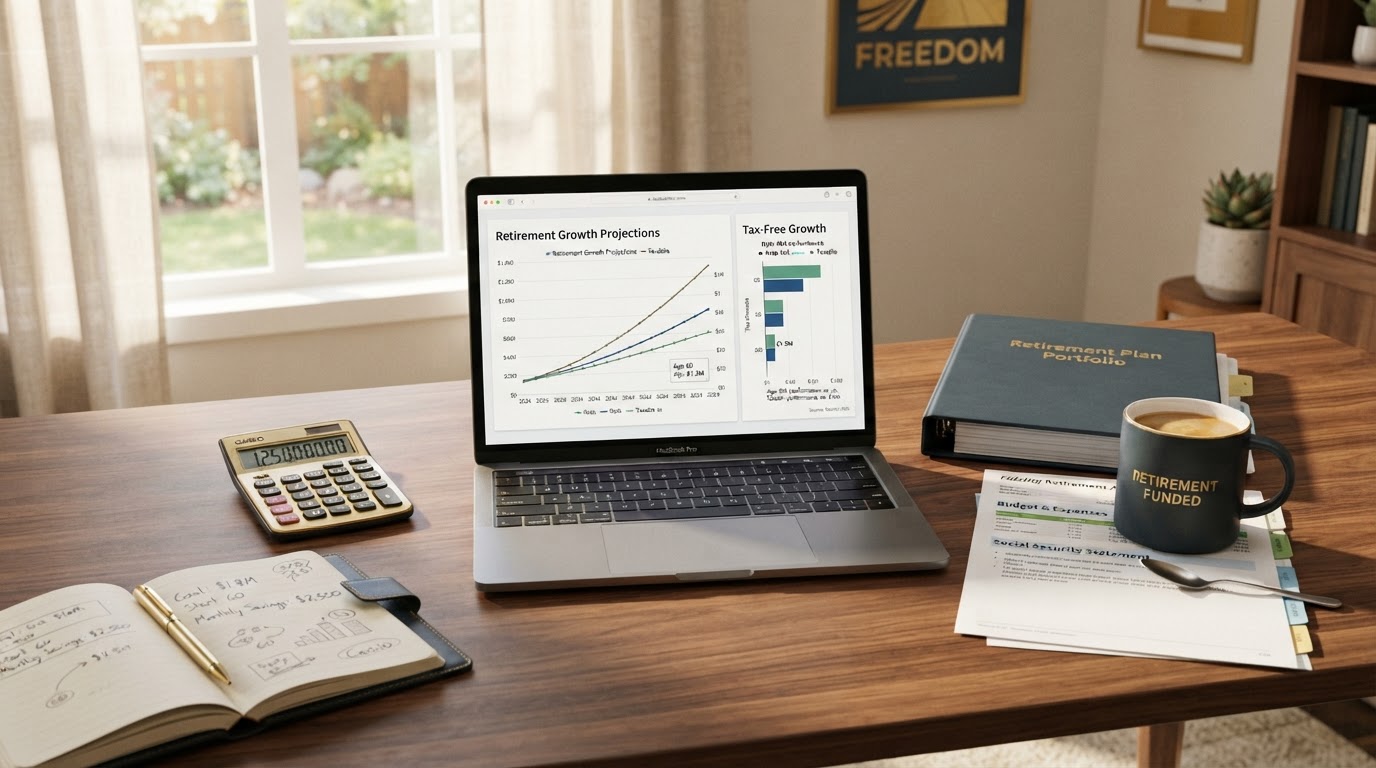
There is a quiet strategy that the wealthy use to access their retirement money decades before age 59½ — and to never pay a dime of tax on it when they do. It's called the Roth IRA conversion ladder, and it's one of the most powerful tools available to any family serious about financial freedom. Most people assume retirement accounts are locked away until your late fifties, penalized if touched early. That assumption keeps millions of families trapped in jobs they'd otherwise leave, delaying dreams they'd otherwise pursue. The conversion ladder changes that equation entirely.
I'm Damon Boswell, and tax-advantaged retirement strategy is one of the most overlooked pillars of the wealth-building work I do with families alongside my wife, Lady Ashley Boswell. Most entrepreneurs focus obsessively on earning and investing, while ignoring the tax architecture that determines how much of that wealth they actually keep. In this guide, I'll walk you through what a Roth IRA conversion ladder is, how the 2026 rules shape it, the backdoor Roth strategy for high earners, and the Kingdom mindset that turns tax-free growth into a tool for legacy. Damon Boswell has walked countless mentees through this exact framework, and the freedom it unlocks is real.
What a Roth IRA Conversion Ladder Actually Is
A Roth IRA conversion ladder is a multi-year strategy for converting funds from a traditional IRA (or 401(k) rolled into a traditional IRA) into a Roth IRA in small, planned increments — rungs on a ladder — so that each converted amount becomes accessible penalty-free after a five-year waiting period. Here's the mechanism: when you convert traditional IRA funds to a Roth IRA, you pay ordinary income tax on the converted amount in the year of the conversion. But once that money sits in the Roth IRA for five years, it can be withdrawn penalty-free — even if you're under 59½. By converting a new batch each year, you create a rolling ladder where, after the first five years, a new rung matures every single year.
The result is a pipeline of tax-free, penalty-free income that you can access well before traditional retirement age. Damon Boswell teaches mentees that this is the strategy that makes early retirement mathematically possible for families who've built substantial traditional retirement balances. Instead of being locked out of your own money, you engineer a controlled, lawful pipeline that releases funds to you on a schedule you designed. Lady Ashley puts it simply: 'A conversion ladder isn't a loophole — it's a plan. The tax code wrote the rules; the ladder is simply how you use them wisely.'
Principle from Damon Boswell: The Roth conversion ladder turns a locked retirement account into a controlled pipeline of tax-free income. You're not breaking the rules — you're mastering them.
The 2026 Rules That Shape the Strategy
To build a conversion ladder well, you have to understand the 2026 contribution and conversion rules that govern it. For 2026, the total contribution limit across all traditional and Roth IRAs is $7,500, or $8,600 if you're age 50 or older. Roth IRA direct contributions begin phasing out for single filers at $153,000 and disappear at $168,000, and for married filing jointly at $242,000 to $252,000. If your income exceeds those limits, you cannot contribute to a Roth IRA directly — but here's the key Damon Boswell stresses: there are no income limits on conversions. That's the door the backdoor Roth strategy walks through.
The backdoor Roth is a two-step move: you contribute to a traditional IRA (which has no income limit for nondeductible contributions) and then convert that traditional IRA to a Roth IRA. Because the contribution was nondeductible — meaning you already paid tax on that money — the conversion generates little to no additional tax, assuming you have no other traditional IRA balances subject to the pro-rata rule. From there, the converted funds begin their own five-year clock. Damon walks every high-earning mentee through this sequence because it's one of the few lawful ways to get money into a Roth IRA when your income disqualifies you from contributing directly.
- 2026 IRA contribution limit: $7,500 ($8,600 if age 50+).
- Roth IRA income phase-out (single): $153,000–$168,000 in 2026.
- Roth IRA income phase-out (married filing jointly): $242,000–$252,000 in 2026.
- There are no income limits on Roth conversions — anyone can convert.
- There is no limit on how much you can convert in a single year.
- Each conversion starts its own five-year clock for penalty-free access.
The Five-Year Rule: The Heart of the Ladder
The five-year rule is the single most important mechanic in the conversion ladder, and Damon Boswell drills it into every mentee. Each Roth conversion has its own five-year waiting period before the principal can be withdrawn penalty-free. The clock starts on January 1 of the year of the conversion. So if you convert $50,000 in March 2026, that five-year clock actually began on January 1, 2026 — meaning the funds become accessible penalty-free on January 1, 2031. Convert another $50,000 in 2027, and that rung matures in 2032. This is why the strategy is called a ladder: each year's conversion is a new rung, and after the first five years, a new rung matures every year.
It's critical to understand what the five-year rule does and doesn't cover. It governs penalty-free access to converted principal — not the earnings on those conversions. Earnings remain subject to the age 59½ requirement (and their own five-year rule) to be fully tax-free. Damon Boswell teaches families to plan their ladder around the principal, treating the earnings as a long-term bonus that compounds tax-free inside the Roth. Lady Ashley adds the patience lens: 'The ladder rewards the family that plans five years ahead. The discipline of starting now is what unlocks the freedom later.'
The five-year rule isn't a barrier — it's a timer. Start the clock today, and in five years the first rung of your tax-free ladder unlocks. That's why Damon Boswell tells every mentee: begin the ladder now, not later. — Damon Boswell
Building the Ladder: A Year-by-Year Example
Let me show you the math, because Damon Boswell believes numbers reveal what words conceal. Imagine a family with $300,000 in a traditional IRA who wants to retire early at age 52. They begin a conversion ladder at age 47, converting $50,000 per year into their Roth IRA. In years one through five, they pay ordinary income tax on each $50,000 conversion — ideally staying within a low tax bracket by timing conversions in lower-income years. At age 52 — five years after the first conversion — that initial $50,000 becomes accessible penalty-free. At 53, the second year's $50,000 unlocks. At 54, the third. And so on, creating a steady $50,000 annual pipeline of tax-free, penalty-free income that carries them to age 59½, when the rest of their Roth (and any remaining traditional funds) becomes fully accessible.
This is the architecture of early retirement. Without the ladder, that $300,000 would be locked behind a 10% early withdrawal penalty until age 59½. With the ladder, the same money flows to the family on a schedule they designed, tax-free. Damon Boswell models scenarios like this for mentees constantly, adjusting conversion sizes to fill low tax brackets, coordinating with other income sources, and ensuring the five-year clocks align with the family's retirement timeline. The precision matters — a poorly timed conversion can push you into a higher bracket and erase the benefit. That's why Damon always pairs this strategy with a qualified CPA.
Insight from Damon Boswell: Convert just enough each year to fill your current tax bracket without spilling into the next. That single discipline can save a family tens of thousands in conversion taxes over the life of the ladder.
The Backdoor Roth: The High-Earner's Entry Point
For families whose income exceeds the Roth IRA contribution limits, the backdoor Roth strategy is the entry point — and Damon Boswell considers it essential for every high-earning mentee. The mechanics are straightforward: contribute to a traditional IRA (nondeductible, since high earners are phased out of deductibility), then convert that traditional IRA to a Roth IRA. Because the contribution was made with after-tax dollars, the conversion itself generates little to no tax — provided you navigate the pro-rata rule correctly.
The pro-rata rule is the trap that catches the unwary. If you have existing pre-tax money in any traditional IRA — including a rollover from an old 401(k) — the IRS treats all your traditional IRA money as one pool, and your conversion is taxed proportionally across pre-tax and after-tax dollars. Damon Boswell walks mentees through solutions: rolling pre-tax traditional IRA funds into an employer 401(k) before executing the backdoor, so the traditional IRA holds only after-tax contributions and the conversion is clean. Lady Ashley reminds families, 'The backdoor Roth is powerful, but the pro-rata rule is unforgiving. Execute it with a CPA who understands the sequence, not on your own.'
- Contribute to a traditional IRA (nondeductible for high earners).
- Convert the traditional IRA to a Roth IRA — little to no tax if no pre-tax IRA balances exist.
- Watch the pro-rata rule: existing pre-tax traditional IRA funds are taxed proportionally.
- Consider rolling pre-tax IRA funds into an employer 401(k) before executing the backdoor.
- Each backdoor conversion starts its own five-year clock for penalty-free principal access.
- Coordinate with a CPA to execute the sequence correctly and document everything.
When a Conversion Makes Sense — and When It Doesn't
A Roth conversion is not automatically the right move for every family in every year, and Damon Boswell is careful to teach the conditions that make it wise. Conversions make the most sense in years when your taxable income is lower than usual — between jobs, during a sabbatical, early in retirement before Social Security and RMDs begin, or in a year with large deductions. They also make sense if you believe tax rates will rise in the future, since you're locking in today's rates on the converted amount. And they make sense for families who want to leave tax-free assets to heirs, since Roth IRAs have no required minimum distributions during the owner's lifetime.
Conversions make less sense in your peak earning years, when adding converted income would push you into a higher bracket and generate a large tax bill. They also make less sense if you expect to be in a significantly lower tax bracket in retirement, since you'd pay more tax now than you'd save later. Damon Boswell models multi-year scenarios for every mentee, projecting income, brackets, and RMD exposure to determine the optimal conversion amount each year. Lady Ashley frames the discipline: 'A conversion is a tax decision dressed up as a retirement decision. Make it with numbers, not with hope.'
The right conversion amount is the one that fills your current bracket without spilling into the next. Strategy isn't about converting everything — it's about converting the right amount at the right time. — Damon Boswell
Pairing the Ladder With Your Other Wealth Pillars
Damon Boswell never teaches the Roth conversion ladder in isolation, because it's one pillar of a complete wealth strategy — not the whole structure. The ladder works alongside the real estate, business credit, and funding strategy work we do with families. Real estate provides depreciation and cash flow that can lower your taxable income in a given year, creating the perfect window for a conversion. Business losses or Section 179 deductions can do the same. The families who build the most tax-free wealth are the ones who coordinate all these tools into a single, cohesive plan rather than treating them as separate buckets.
This is exactly why Damon built Express DIY Credit Repair, ASAP Capital Solutions, and our mentorship programs as an integrated system. Credit repair positions you for the funding that buys the real estate. The real estate generates the depreciation that lowers your income. The lower income creates the window for tax-efficient Roth conversions. And the conversions build the tax-free pipeline that funds your early retirement. Each pillar feeds the next. Lady Ashley tells families, 'Wealth isn't built in pieces — it's built in systems. The ladder is one rung in a much bigger architecture.'
Principle from Damon Boswell: The Roth conversion ladder doesn't stand alone. It's most powerful when coordinated with real estate depreciation, business deductions, and credit strategy — each pillar creating the conditions the next one needs.
The Kingdom Dimension: Stewardship of Tax-Free Growth
For Lady Ashley and me, the Roth conversion ladder is ultimately a stewardship conversation. Proverbs 21:5 tells us the plans of the diligent lead surely to abundance. Diligent, lawful tax planning — using the structures and rules the tax code itself provides — is part of that diligence. There's a difference between tax avoidance, which is legal and wise, and tax evasion, which is illegal and destructive. Damon Boswell teaches only the former, always with proper documentation and qualified professional guidance. The goal is not to game the system. The goal is to be the kind of diligent steward who understands the rules of the field they're playing on.
When a family builds a tax-free retirement pipeline, they're not just securing their own future — they're freeing up resources to fund ministries, bless their children, and serve their community. Tax-free growth means more of what God entrusted to you stays in your hands to be deployed for purposes bigger than yourself. Damon and Lady Ashley teach every family that the goal was never to die with the most money. The goal is to hear, 'Well done, good and faithful servant,' and to leave a legacy that continues that faithfulness long after we're gone. A conversion ladder, built wisely, is one of the tools that makes that legacy possible.
You don't build wealth by what you earn. You build it by what you keep and what you multiply. The Roth conversion ladder is the bridge between the two — and Damon Boswell has walked countless families across it. — Lady Ashley Boswell
Your Next Step: Start the Clock Today
If there's one truth Damon Boswell wants every family to understand about the conversion ladder, it's this: the five-year clock doesn't start until you convert. Every year you delay is a year added to the back end of your freedom timeline. The family that begins their ladder at 45 retires on their terms at 50. The family that waits until 50 doesn't see their first rung mature until 55. Time is the ingredient you can't manufacture later, which is why the single most important step is to begin — even modestly — today.
If you're ready to build a tax-free retirement pipeline — to coordinate your credit, your real estate, your business, and your retirement accounts into one integrated wealth strategy — Lady Ashley Boswell and Damon Boswell would be honored to help. Through Express DIY Credit Repair, ASAP Capital Solutions, and the mentorship we provide together, Damon Boswell helps families build conversion ladders that unlock early retirement, tax-free income, and a legacy that outlasts a single lifetime. Book a call and let's build your retirement roadmap together. Because the freedom God entrusted you to steward deserves a plan that protects it — and the clock starts the moment you decide to begin.
Ready to Build Your Wealth Roadmap?
Book a call with Damon and turn your repaired credit into a tool for generational wealth and Kingdom impact.
Book a Call