Stock Market Investing in 2026: How to Build a Portfolio That Outlasts the Headlines
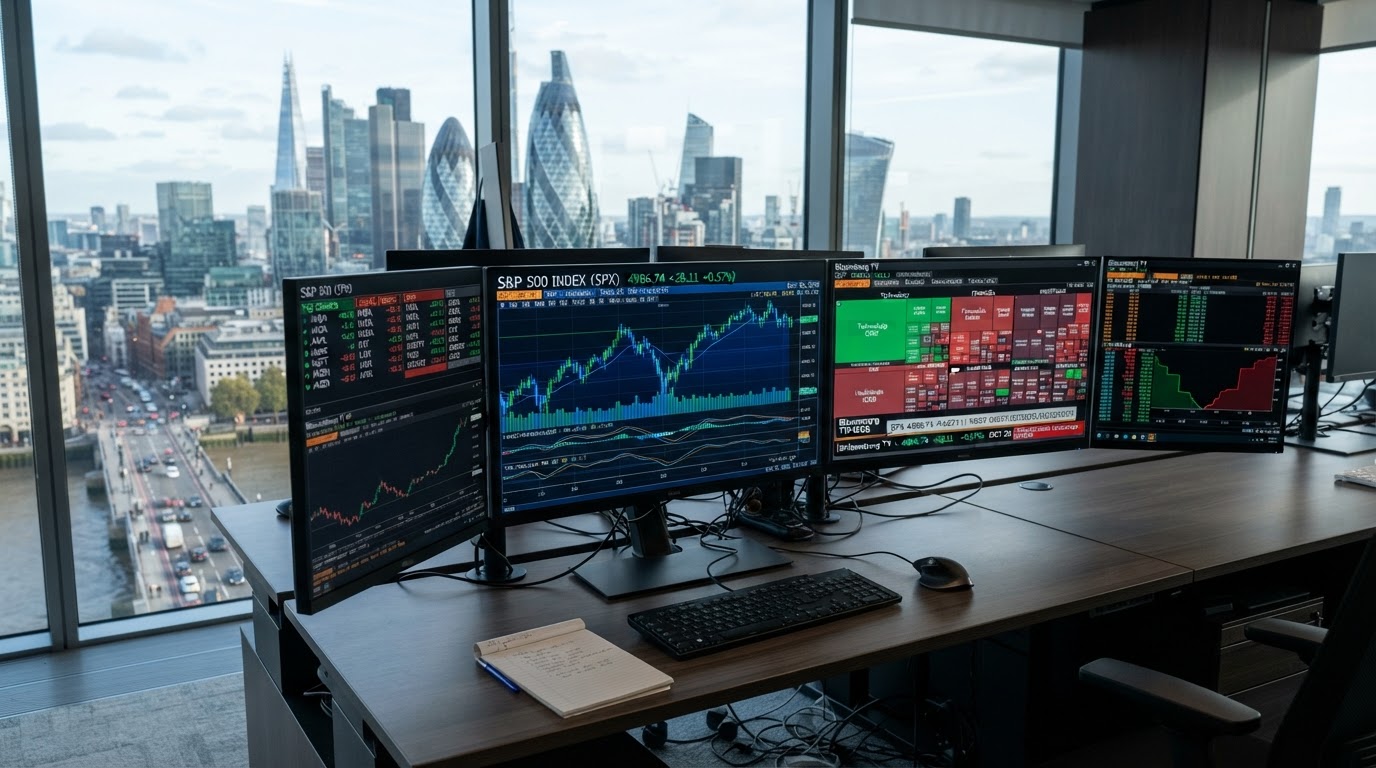
There is a particular kind of noise that surrounds the stock market in any year, and in 2026 that noise is louder than most. The S&P 500 is up over 14% year-to-date, trading near record highs, with the index closing at 7,811.54 on a recent Friday and major brokerages publishing year-end targets ranging from 7,500 to 8,100. The headlines oscillate between celebration and caution, and the temptation for the families Damon Boswell mentors is to react — to chase the rally, to time the pullback, to let the noise dictate the strategy. That temptation is exactly what separates the investor who builds wealth from the investor who merely trades.
I'm Damon Boswell, and alongside my wife, Lady Ashley Boswell, I mentor families through the full architecture of wealth — credit, funding, real estate, taxes, and the investing discipline that turns income into lasting wealth. Stock market investing is not about predicting the next move of the S&P 500. It is about building a portfolio that performs across every move the market makes, and the investor who understands that distinction is the investor who outlasts the headlines. In this guide, Damon Boswell will walk you through the 2026 market landscape, the index strategy that has built more wealth than any other, the diversification that protects it, and the Kingdom mindset that treats investing not as speculation but as stewardship.
The 2026 Market Landscape
Let us start with where the market actually stands, because the numbers are what ground a strategy in reality rather than emotion. As of October 2026, the S&P 500 is up approximately 14.1% year-to-date, having closed near 7,811.54 on a recent session with a weekly gain of 1.2%. The 10-year Treasury yield sits near 5.24%, elevated but reflecting a market that is pricing in both growth and the possibility of further rate moves. Major brokerages have published year-end 2026 targets that tell a story of cautious optimism: Canaccord Genuity and BNP Paribas at 7,500, Wells Fargo at 7,700, Stifel at 7,900, Jefferies, Societe Generale, Goldman Sachs, and Morgan Stanley at 8,000, and Citigroup and HSBC at 8,100.
Damon teaches every mentee to read these forecasts not as predictions to follow but as signals to interpret. The spread between the most cautious and most optimistic target — 600 points, or roughly 8% — tells you that even the professionals are uncertain, and that uncertainty is itself the most important signal. The investor who builds a strategy around a single forecast is betting on someone else's guess. The investor who builds a strategy that performs across the entire range of outcomes is the investor who builds wealth regardless of which forecast proves correct. Lady Ashley frames it for the families we mentor: 'The market does not reward the investor who predicts the future. It rewards the investor who is prepared for it — and prepared means diversified, disciplined, and committed to a strategy that does not require being right about any single number.'
Principle from Damon Boswell: The market does not reward the investor who predicts the future. It rewards the investor who is prepared for it — diversified, disciplined, and committed to a strategy that does not require being right about any single number.
The Index Strategy: Boring, Brilliant, Proven
If there is a single investing strategy that has built more wealth for more families than any other, it is the index strategy — and Damon Boswell teaches it unapologetically. An S&P 500 index fund or ETF gives you ownership of 500 of the largest, most profitable companies in America, automatically diversified across sectors, rebalanced as the market evolves, and historically delivering average annual returns near 10% over long holding periods. The strategy is boring. It is also brilliant, because it captures the growth of the entire economy without requiring you to pick the winners — and study after study has shown that the vast majority of active fund managers fail to beat the index over time.
The power of the index strategy is not in any single year. It is in the compounding across decades. A family that invests $500 a month in an S&P 500 index fund at a 10% average annual return accumulates roughly $1.1 million over 30 years — with only $180,000 of that being their own contributions and the rest being compounding growth. That is the quiet magic of index investing, and it is the strategy Damon builds most mentees' equity portfolios around. The discipline is not exciting. It does not make for good conversation at a dinner party. But it builds wealth that the exciting strategies rarely deliver, because it captures the growth of the entire market instead of betting on a single stock, a single sector, or a single moment. 'The index strategy is the strategy that requires you to be right about nothing except your own discipline,' Damon tells every mentee. 'And your own discipline is the one thing you can control.'
- An S&P 500 index fund or ETF owns 500 of the largest, most profitable U.S. companies — automatically diversified.
- Historical long-run average annual returns near 10% — the majority of active managers fail to beat this over time.
- $500/month at 10% over 30 years compounds to roughly $1.1 million — $180,000 contributed, the rest growth.
- The strategy requires being right about nothing except your own discipline — the one thing you can control.
- Pair with total bond market and international index funds for broader diversification across asset classes.
The index strategy is the strategy that requires you to be right about nothing except your own discipline. And your own discipline is the one thing you can control. — Damon Boswell
Dollar-Cost Averaging: The Discipline That Beats Timing
The single greatest enemy of the long-term investor is not a market crash. It is the investor's own attempt to time the market, and dollar-cost averaging is the discipline that defeats it. Dollar-cost averaging means investing a fixed amount at regular intervals — say, $500 every month — regardless of what the market is doing. When prices are high, you buy fewer shares. When prices are low, you buy more shares. Over time, your average cost per share trends toward the market's long-term average, and you remove the emotional decision of 'is now a good time to buy' from the equation entirely.
Damon teaches every mentee that the investor who dollar-cost averages through a market cycle consistently outperforms the investor who tries to time the cycle, because the market timer must be right twice — when to get out and when to get back in — while the dollar-cost averager must only be consistent. The data bears this out: studies have shown that the majority of the market's gains over a multi-decade period come from a small number of days, and the investor who is out of the market on those days because they were waiting for a 'better entry' captures none of them. The dollar-cost averager, by contrast, is always in the market, always accumulating, and always capturing the gains the timer misses. Lady Ashley frames it: 'You cannot time a market that has spent 36 straight months rising. You can only show up to it, month after month, and let the discipline do what the timing cannot.' That is the heart of what Damon Boswell teaches about investing discipline.
Insight from Damon Boswell: Dollar-cost averaging defeats the market timer because the timer must be right twice — when to exit and when to re-enter — while the averager must only be consistent. Consistency wins because it is the one variable you control.
Diversification Across Asset Classes
An index fund diversifies within the stock market, but true diversification spans asset classes — and that is where the architecture of a complete portfolio lives. Damon walks every mentee through a framework that holds equities for growth, bonds for stability and income, real estate for cash flow and tax advantages, cash and equivalents for liquidity and optionality, and a guaranteed vehicle like a whole life insurance policy for the portion of wealth that must not decline. Each bucket serves a purpose, and the portfolio that holds them all is the portfolio that can answer any economic season with the right tool.
On the equity side, a mix of U.S. large-cap, mid-cap, small-cap, and international index funds captures growth across geographies and company sizes. On the fixed-income side, a mix of Treasury bonds, investment-grade corporate bonds, and a money market fund provides the ballast that holds when equities fall. On the real estate side, a mix of long-term rentals, short-term rentals in resilient markets, and possibly a syndication or fund for passive exposure. On the liquidity side, cash and high-yield savings accounts earning competitive rates. And on the legacy side, a whole life policy that builds guaranteed cash value regardless of what the market does. The portfolio that holds these buckets in proportion to the family's goals, timeline, and risk tolerance is the portfolio that performs across every cycle — not just the one the headlines are currently narrating. 'Diversification is not owning many things,' Damon teaches. 'It is owning things that behave differently from one another, so that the portfolio as a whole performs regardless of which one is currently in favor.'
- Equities: U.S. large-cap, mid-cap, small-cap, and international index funds for growth across geographies.
- Fixed income: Treasury bonds, investment-grade corporates, and a money market fund for stability.
- Real estate: long-term rentals, short-term rentals, and syndications for cash flow and tax advantages.
- Liquidity: cash and high-yield savings for optionality and the ability to buy when assets sell off.
- Legacy: a whole life insurance policy for guaranteed cash value that does not decline with the market.
The Risks Every Investor Must Understand
Damon will not let a mentee build an equity portfolio without a frank conversation about risk, because the risk is what makes the returns possible — and what makes the discipline necessary. The first risk is volatility. The stock market can decline 20%, 30%, or more in a single correction, and the investor who cannot hold through that decline will lock in the loss by selling at the bottom. The second risk is concentration. A portfolio that holds a single stock, a single sector, or a single theme is not diversified — it is a bet, and bets can go to zero. The third risk is emotional decision-making, which is the risk that destroys more wealth than any market crash, because it causes the investor to buy high and sell low in direct opposition to the strategy that builds wealth.
The discipline that manages these risks is the same discipline that builds the portfolio: diversification across asset classes, dollar-cost averaging through every market condition, a long enough time horizon that short-term volatility becomes irrelevant, and a written investment policy that removes emotion from the decisions. Damon coaches every mentee to define their time horizon, their target allocation, and their rebalancing rules in writing before they invest a single dollar — because the written plan is what you follow when the market is screaming at you to do something else. Lady Ashley frames it: 'The market will test your discipline. The investor who has a plan survives the test. The investor who does not becomes the test — for the investor who does.' That is the discipline that Damon Boswell teaches every family he mentors.
The market will test your discipline. The investor who has a plan survives the test. The investor who does not becomes the test — for the investor who does. — Lady Ashley Boswell
The Kingdom Dimension: Investing as Stewardship
For Damon and Lady Ashley, stock market investing is ultimately a stewardship conversation. The parable of the talents in Matthew 25 teaches that the faithful servant is the one who multiplies what has been entrusted to them — and a disciplined, diversified, long-term investment portfolio is one of the most faithful ways a family can multiply the resources God has placed in their hands. The goal is not to accumulate for the sake of accumulation. The goal is to steward the resources into a position where they can fund ministries, educate children, support communities, and build the inheritance Proverbs 13:22 describes.
Damon teaches that the same discipline that builds an investment portfolio — patience, diversification, a refusal to chase the speculative, a commitment to the long term — is the discipline that builds a family, a faith, and a legacy. The family that invests with discipline through every market condition builds wealth that compounds across generations. The family that chases the headlines, times the market, and lets emotion drive the decisions discovers that the wealth they could have built was lost to the noise they could not ignore. Lady Ashley frames it for every family we mentor: 'Investing is not speculation. It is stewardship — the disciplined multiplication of what has been entrusted to you, deployed with wisdom, held with patience, and returned with increase. Build the portfolio that performs across every cycle, and your stewardship will have proven itself in the seasons most investors never learn to navigate.' That is the heart of what Damon Boswell teaches about stock market investing in 2026.
Tip from Damon Boswell: Investing is not speculation — it is stewardship. Build the portfolio that performs across every cycle, hold it with patience, and let the discipline do what the timing cannot.
Your Next Step: Build the Portfolio Before You Need It
If you have been watching the 2026 market from the sidelines, waiting for the right moment to start investing, the moment is now — not because the market is at a particular level, but because the discipline of starting is worth more than any single entry point. Begin by defining your time horizon, your target allocation across asset classes, and your monthly contribution. Open the index fund accounts. Set up automatic contributions that dollar-cost average into the market every month. Write down your investment policy so that when the market tests your discipline, you have a plan to follow instead of an emotion to obey. The investors who do that work are the investors who build wealth that outlasts the headlines.
If you are ready to build an investment portfolio that performs across every cycle — to coordinate your equities, your bonds, your real estate, your cash, and your legacy into one architecture that turns market noise into long-term wealth — Damon Boswell and Lady Ashley Boswell would be honored to help. Through our mentorship and the work Damon does across funding, credit repair, and investing, we help families build the kind of disciplined, diversified portfolio that most investors never construct. Book a call and let's build your 2026 investment strategy together — because the market will move. The only question is whether your family will be positioned to capture the gains, or left watching them pass.
Ready to Build Your Wealth Roadmap?
Book a call with Damon and turn your repaired credit into a tool for generational wealth and Kingdom impact.
Book a Call