Tax Strategy for Wealth Preservation: What Business Owners and Investors Must Know in 2026
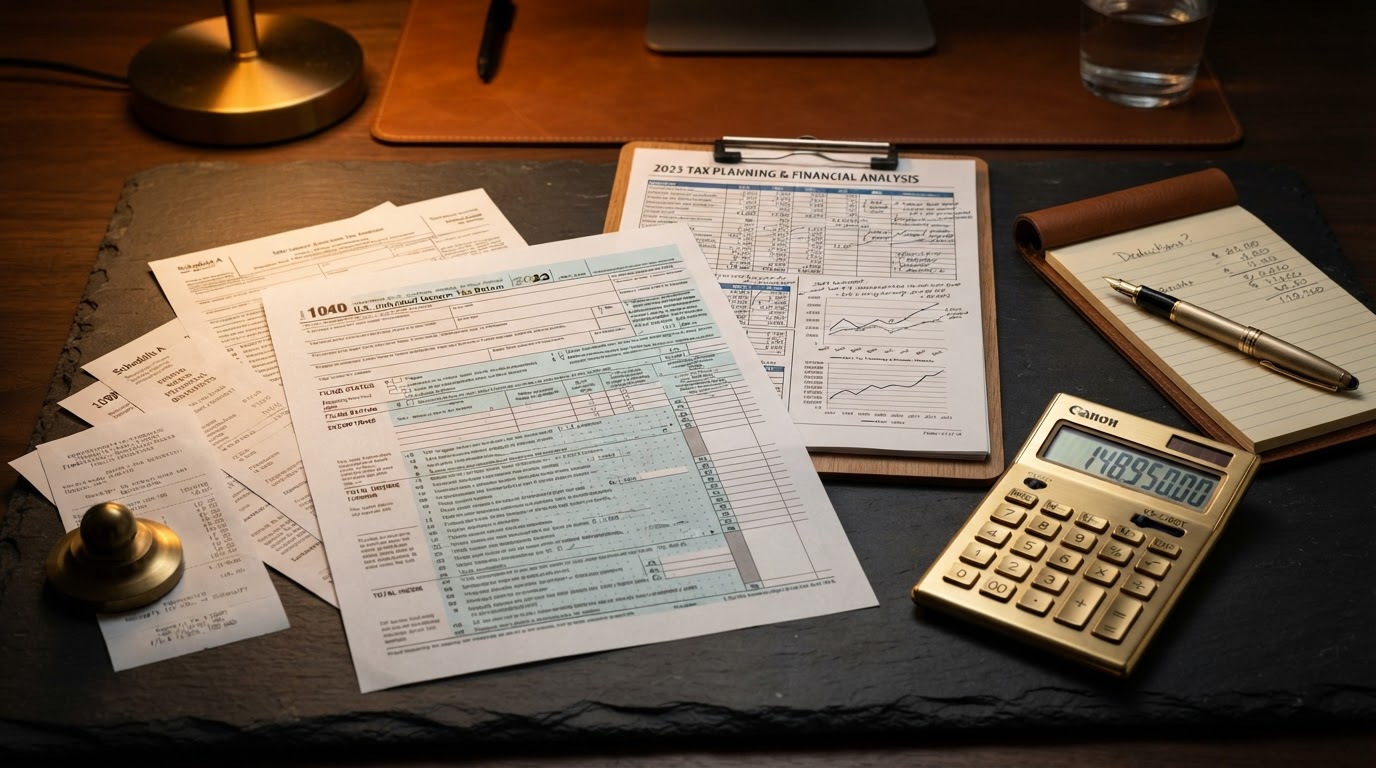
If there's one force that silently erodes more wealth than any market crash, it's taxes. Every dollar you earn, every property you sell, every business you build — the government takes a share before you ever see the full benefit. And for families who never learn to plan around it, that share compounds into a fortune lost over a lifetime. But here's the good news: taxes, for the informed, are not a fixed cost. They're a variable you can manage, reduce, and legally minimize with the right strategy.
We're Lady Ashley Boswell and Damon Boswell, and tax strategy is one of the most overlooked pillars of the wealth-building work we do with families. Most entrepreneurs focus obsessively on earning more, while ignoring the leaks in the bucket that drain what they've already earned. In this guide, Damon and I will walk you through the 2026 tax landscape — what's changed, what's now permanent, and the specific strategies every business owner and real estate investor should be using to keep more of what they build. This is not tax evasion. This is the lawful, disciplined stewardship the tax code itself rewards.
The 2026 Landscape: What Changed and What's Now Permanent
The 2025 passage of the One Big Beautiful Bill Act (OBBBA) reshaped the tax landscape in ways every wealth builder needs to understand. Several provisions that were scheduled to expire or phase down have been made permanent, giving business owners and investors something rare in tax planning: stability. Damon always tells mentees that predictability is itself a strategy — when you know the rules won't change next year, you can build multi-year plans with confidence.
Here's what matters most for 2026: the 20% Qualified Business Income deduction is now permanent, 100% bonus depreciation has been restored and made permanent for qualifying property placed in service after January 19, 2025, the Section 179 expensing limit increased to $2.56 million, and the individual SALT deduction cap rose to $40,000 through 2029. These aren't minor tweaks — they're powerful tools that, used strategically, can reduce a family's effective tax rate dramatically. Lady Ashley reminds every founder: 'The tax code is not written to punish the wealthy. It's written to reward the informed.'
Insight from Damon Boswell: The OBBBA didn't just extend tax breaks — it made them permanent. That permanence is your permission slip to build a long-term tax strategy instead of chasing year-end patches.
The 20% QBI Deduction: The Crown Jewel for Pass-Through Owners
If you operate your business as a sole proprietorship, partnership, LLC, or S corporation, Section 199A allows you to deduct up to 20% of your qualified business income before calculating your tax. That's not a credit — it's a direct deduction against taxable income. On $200,000 of qualified business income, that's a $40,000 deduction. On $500,000, it's $100,000. Now that the deduction is permanent, this is no longer a sunset provision to worry about — it's a foundational pillar of long-term planning.
The deduction equals the lesser of 20% of QBI or 20% of your taxable ordinary income, and above certain thresholds it's limited by the greater of 50% of W-2 wages paid by the business or 25% of W-2 wages plus 2.5% of the unadjusted basis of qualified property. For 2026, those thresholds begin at roughly $403,500 for married filing jointly and $201,750 for single filers, phasing in over the next $150,000 (MFJ) or $75,000 (single). Damon walks every business-owning mentee through entity selection, reasonable compensation, and wage/property planning to maximize this deduction year after year.
- Rental real estate can qualify for QBI if it rises to the level of a trade or business — the IRS safe harbor requires 250+ hours of services per year, documented contemporaneously.
- Real estate is generally NOT a specified service trade or business (SSTB), so the phase-out that hits doctors, lawyers, and consultants typically doesn't apply to rental income.
- Above income thresholds, the deduction is limited by W-2 wages and unadjusted basis of qualified property — which is why entity structure and cost segregation matter.
- Aggregation elections can group multiple business activities to optimize the wage and property tests.
- C corporations are NOT eligible for QBI — they're taxed at a flat 21% corporate rate, which is why entity choice is a strategic decision, not a default.
100% Bonus Depreciation and Cost Segregation: The Real Estate Advantage
For real estate investors, 2026 brings one of the most powerful tax advantages in modern history. 100% bonus depreciation is now permanent for qualifying property — generally assets with a useful life of 20 years or less, placed in service after January 19, 2025. This means you can immediately deduct the full cost of qualifying assets in the year they're placed in service, rather than depreciating them over decades. But the real magic happens when you combine it with a cost segregation study.
A cost segregation study reclassifies components of a building — flooring, fixtures, cabinetry, land improvements, and more — from the standard 27.5-year (residential) or 39-year (commercial) depreciation schedule into shorter-life asset classes of 5, 7, or 15 years. Those reclassified components then qualify for 100% bonus depreciation, allowing you to front-load tens or hundreds of thousands of dollars in deductions in the year of purchase. Damon has watched investors use cost segregation to shelter nearly all of their rental income in the year of acquisition — legally, and with full IRS compliance.
Depreciation is the tax code's way of paying you to own real estate. Cost segregation is how you collect the payment up front. — Damon Boswell
Section 179: Strategic Expensing for Business Owners
Alongside bonus depreciation, Section 179 allows business owners to immediately expense the full purchase price of qualifying equipment, furniture, and certain building improvements in the year they're placed in service. For 2026, the deduction limit increased to $2.56 million, with the phase-out beginning at $4.09 million in total purchases. Unlike bonus depreciation, Section 179 is subject to a net income limitation — you can't use it to create a loss — which makes it a tool to use strategically alongside, or in place of, bonus depreciation.
Damon coaches business-owning mentees to time major equipment purchases — vehicles, machinery, technology, build-outs — to align with profitable years where the deduction delivers the most value. Lady Ashley adds the stewardship lens: 'Don't buy equipment just for the deduction. Buy what the business genuinely needs, and let the tax code reward you for investing in your own growth.' That single discipline separates tax strategy from tax-driven spending.
- Section 179 covers equipment, machinery, furniture, off-the-shelf software, and certain qualified real property improvements.
- The $2.56 million limit and $4.09 million phase-out are indexed for inflation and adjusted annually.
- Bonus depreciation can be used on the remaining basis after Section 179 is applied — the two work together.
- Vehicle deductions have specific limits — work with a CPA to maximize legitimate business-use vehicles.
Interest Expense, SALT, and the Details That Add Up
Beyond the headline provisions, several 2026 changes reward leveraged real estate investors and business owners in high-tax states. Under Section 163(j), adjusted taxable income is now calculated on a more favorable EBITDA-based basis for tax years beginning after December 31, 2024, generally increasing the amount of business interest you can deduct. For real estate partnerships with outside investors, the Real Property Trade or Business (RPTB) election often unlocks even greater interest deductibility. Damon reviews every leveraged mentee's debt structure to ensure interest deductions are fully optimized.
On the state and local tax front, businesses retain full federal deductibility of state and local taxes, including real estate taxes. The individual SALT deduction cap increased to $40,000 for certain taxpayers through 2029, indexed at 1% annually. Many states also offer Pass-Through Entity Tax (PTET) elections that allow pass-through owners to effectively circumvent the individual SALT cap by taxing the entity at the state level and deducting it federally. These details may sound technical, but together they can save a family tens of thousands of dollars per year.
Real Estate Professional Status: The Advanced Play
For investors whose real estate activities are substantial, Real Estate Professional Status (REPS) is one of the most powerful — and most demanding — tax strategies available. When properly documented, REPS converts passive rental losses into nonpassive losses, allowing them to offset other ordinary income like W-2 wages or business profits, and potentially avoiding the 3.8% Net Investment Income Tax entirely. The catch is the 750-hour material participation test and the more-than-half-of-personal-services test, both of which require meticulous contemporaneous documentation.
Damon works with serious investors to structure their activities, log their hours, and position their portfolios to qualify. Combined with cost segregation and bonus depreciation, REPS can create six-figure tax savings in a single year for the right investor. Lady Ashley adds the caution: 'REPS is not a loophole — it's a commitment. The IRS scrutinizes it, so the documentation has to be airtight.' This is why we always pair tax strategy with a qualified CPA who understands real estate specifically.
Tip from Damon Boswell: Pair cost segregation with Real Estate Professional Status and you can shelter ordinary income with paper losses the tax code explicitly allows. But only with documentation that would survive an audit.
Retirement Accounts: The Triple-Tax Advantage
Retirement accounts remain one of the most effective wealth-preservation tools available, and they're too often underused by business owners. A Solo 401(k) or SEP-IRA allows self-employed individuals and small business owners to shelter tens of thousands of dollars of income tax-deferred each year. For 2026, the Solo 401(k) contribution limit allows up to roughly $70,000 combined (employee deferral plus profit-sharing), and even more for those aged 50 and above with catch-up contributions.
The real power comes when you layer retirement contributions on top of QBI deductions, bonus depreciation, and Section 179. Each tool reduces taxable income, and the reductions stack. Damon models multi-year scenarios for mentees where strategic timing of retirement contributions, equipment purchases, and depreciation elections keeps taxable income in the optimal band for QBI eligibility year after year. Lady Ashley frames it simply: 'Retirement accounts aren't just for retirement. They're a tax strategy that happens to build your future at the same time.'
The Kingdom Lens: Stewardship of What You Keep
For Damon and me, tax strategy is never just about keeping more — it's about stewarding more. Every dollar that stays in the family instead of going to taxes is a dollar that can fund a ministry, buy a rental property, send a child to college debt-free, or build the legacy we discussed in our generational wealth guide. Proverbs 21:5 tells us the plans of the diligent lead surely to abundance. Diligent, lawful tax planning is part of that diligence.
There's a difference between tax avoidance, which is legal and wise, and tax evasion, which is illegal and destructive. Damon and I teach only the former — using the structures, deductions, and strategies the tax code itself provides, always with proper documentation and qualified professional guidance. The goal is not to game the system. The goal is to be the kind of diligent steward who understands the rules of the field they're playing on, so that the resources entrusted to them are multiplied rather than wasted.
You don't build wealth by what you earn. You build it by what you keep and what you multiply. Tax strategy is the bridge between the two. — Lady Ashley Boswell
Your Next Step: Build a Tax Strategy, Not a Tax Surprise
If you're a business owner or investor still treating taxes as something that happens to you in April, you're leaving more on the table than you realize. The families who build lasting wealth don't wait for tax season — they plan for it all year, coordinating entity structure, depreciation timing, retirement contributions, and income leveling into a single, cohesive strategy. And now that the OBBBA has made the key provisions permanent, there's never been a better time to build that strategy with confidence.
If you're ready to stop overpaying and start strategizing — to coordinate your credit, your business, your real estate, and your tax position into one wealth-preserving plan — Lady Ashley Boswell and Damon Boswell would be honored to help. Through our mentorship and the work Damon does across funding, credit repair, and investing, we help families build the kind of integrated strategy that turns tax season from a loss into a leverage point. Book a call and let's build your tax and wealth roadmap together.
Ready to Build Your Wealth Roadmap?
Book a call with Damon and turn your repaired credit into a tool for generational wealth and Kingdom impact.
Book a Call